

Content
- What Are Smart Bidding Strategies? And, Why Should You Care?
- The Top Smart Bidding Strategies You Need to Know
- How to Implement Smart Bidding Strategies Like a Pro
- Overcoming Common Challenges in Smart Bidding
- Finding the Right Partner for Your PPC Journey
- Final Thoughts
The art of pay-per-click (PPC) lies in the details.
Marketing teams spend weeks crafting the perfect PPC campaigns – ad copies, landing pages, everything!
They get the technicalities and creativity right too:
- Keywords? Integrated seamlessly!
- Copy? Attention-grabbing!
- Landing-page? Compelling for conversion!
Yet, when they check performance metrics, something feels off:
Cost per acquisition (CPA) is on the roof.
But, the return on investment (ROI) is not hitting the mark.
Does this sound familiar?
If you’re nodding along, don’t worry – you’re not alone! Many businesses face similar challenges in their PPC advertising efforts.
But, there is a way out! The key is adopting smart bidding strategies that use automation and data-driven insights to maximize ROI.
So, whether working with a search engine marketing agency in Mumbai (a good SEM company located in the western part of India with proven results) or managing campaigns independently, we present some sure-fire techniques that can level up your PPC game.
Let’s get into it!
What Are Smart Bidding Strategies? And, Why Should You Care?
Smart bidding is a form of automated bid strategies powered by machine learning (ML) algorithms.
These tools analyze (in real-time) large amounts of data to adjust bids dynamically, ensuring your ads reach the right audience at the perfect moment.
Unlike manual bidding, which relies heavily on guesswork and constant monitoring, smart bidding handles the heavy lifting for you while delivering improved results.
Here’s why smart bidding deserves your attention:
- Precision Targeting: Algorithms evaluate device type, location, time of day, and user behavior to make informed bidding decisions.
- Time Savings: Automation frees your team to focus on strategy rather than micromanaging bids.
- Higher ROI: Studies show that smart-bidding advertisers often see significant improvements in key metrics like conversion rates and cost efficiency.
The Top Smart Bidding Strategies You Need to Know
Google Ads offers a variety of smart bidding options, each tailored to help advertisers achieve specific objectives.
These strategies use machine learning to analyze real-time data and optimize bids automatically, ensuring your campaigns are as efficient and effective as possible.
Below, we break down the most popular smart bidding strategies, explain how they work, and provide guidance on when to use them.
Top 5 Smart Bidding Strategies Used for PPC Campaigns |
|||
|---|---|---|---|
| Strategy | What It Does | How It Works | Best For |
| Target CPA | Focuses on acquiring customers at a specific cost per acquisition (CPA). | Automatically adjust bids to aim for conversions at or below your target CPA. | - Lead generation campaigns - Subscription-based services - Controlling acquisition costs |
| Target ROAS | Maximizes ad spending by prioritizing clicks likely to result in high-value conversions. | Adjusts bids to achieve a specific return on ad spend (ROAS), e.g., ₹4 revenue for every ₹1 spent. | - E-commerce stores - SaaS companies - High-ticket products/services |
| Maximize Conversions | Aims to get the most conversions possible within your allocated budget. | Distribute your budget across auctions where the algorithm predicts the highest conversion rates. | - Short-term campaigns - Product launches - Testing new markets |
| Enhanced CPC | Combines manual and automated bidding by adjusting base bids to increase conversion likelihood. | Raises or lowers manual bids based on real-time signals like user behavior and device type. | - Transitioning to automation - Incremental improvements - Experimentation |
| Maximize Clicks | Drives as much traffic as possible to your website without focusing on conversions. | Allocates your entire budget toward securing the highest number of clicks. | - Content-heavy websites - Brand awareness campaigns - Top-of-funnel traffic |
1. Target CPA (Cost Per Acquisition)
What It Does:
Target CPA focuses on acquiring customers at a specific cost per acquisition. This strategy uses historical data and predictive analytics to adjust your bids in real-time, ensuring that you stay within your desired CPA while maximizing the number of conversions.
How It Works:
You set a target CPA (e.g., ₹500), and Google Ads automatically adjusts your bids to aim for conversions at or below that cost. For example, if your campaign typically generates a conversion for ₹450, the algorithm will prioritize similar opportunities while avoiding higher-cost prospects.
When to Use It:
This strategy is ideal for businesses with a fixed budget and clear acquisition goals. If your primary focus is generating leads, sign-ups, or other low-cost actions, Target CPA ensures your ad spend aligns with your financial objectives.
Best For:
- Lead generation campaigns (e.g., collecting email addresses or phone inquiries).
- Subscription-based services where controlling customer acquisition costs is critical.
- Any business aiming to maintain a consistent CPA across campaigns.
2. Target ROAS (Return on Ad Spend)
What It Does:
Target ROAS maximizes your ad spend by focusing on high-value conversions. Instead of prioritizing the number of conversions, this strategy targets a specific return on investment (ROI) for every rupee spent on ads.
How It Works:
You define a target ROAS percentage (e.g., 400%), and Google Ads adjusts bids to prioritize clicks likely to result in conversions worth that amount. For instance, if you spend ₹1,000 on ads, the system aims to generate ₹4,000 in revenue.
When to Use It:
If your primary goal is revenue growth and you have a well-defined understanding of your customer lifetime value (CLV), Target ROAS is the perfect choice. It’s especially effective for e-commerce businesses where each sale contributes significantly to overall profitability.
Best For:
- E-commerce stores looking to maximize sales while maintaining profitability.
- SaaS companies with subscription models and predictable CLVs.
- Businesses with high-ticket products or services where individual conversions carry substantial value.
3. Maximize Conversions
What It Does:
As the name suggests, Maximize Conversions aims to drive as many conversions as possible within your allocated budget. Unlike Target CPA or ROAS, this strategy doesn’t require setting a specific cost or return goal—it simply seeks to get the most bang for your buck.
How It Works:
Google Ads automatically adjusts bids to capture the highest number of conversions based on historical performance and available budget. For example, if you allocate ₹50,000 per month, the system will distribute those funds across auctions where it predicts the best chances of converting users.
When to Use It:
This strategy is particularly useful during short-term campaigns, such as product launches, flash sales, or events where generating volume is more important than controlling individual costs.
Best For:
- Short-term promotional campaigns (e.g., holiday discounts or limited-time offers).
- Testing new markets or audiences to gauge interest and gather data.
- Situations where increasing conversion volume takes precedence over strict cost management.
4. Enhanced CPC (Cost Per Click)
What It Does:
Enhanced CPC blends manual and automated bidding by adjusting your base bids to increase the likelihood of conversions. While you retain control over your maximum CPC, the algorithm tweaks bids in real-time based on factors like user behavior, device type, and location.
How It Works:
For example, if a user searches for “best digital marketing agency in Mumbai” and shows strong purchase intent, Enhanced CPC might raise your bid slightly to secure the click. Conversely, it lowers bids for less promising opportunities.
When to Use It:
This strategy serves as an excellent middle ground for businesses transitioning from manual to fully automated bidding. It allows you to experiment with automation while maintaining some level of oversight.
Best For:
- Businesses experimenting with automation but hesitant to fully commit to smart bidding.
- Campaigns where flexibility and incremental improvements are key priorities.
- Advertisers who want to dip their toes into smart bidding without losing complete control.
5. Maximize Clicks
What It Does:
Maximize Clicks focuses on driving traffic to your website rather than prioritizing conversions. This strategy allocates your entire budget toward securing as many clicks as possible, regardless of whether those clicks lead to meaningful actions.
How It Works:
The algorithm identifies keywords, placements, and audiences likely to generate clicks and adjust bids accordingly. For instance, if one keyword consistently attracts visitors, the system will allocate more budget.
When to Use It:
Use Maximize Clicks when your primary objective is increasing brand awareness or driving traffic to content-heavy pages. Since this strategy doesn’t focus on conversions, it’s not suitable for direct-response campaigns.
Best For:
- Content-heavy websites, blogs, or informational pages aiming to boost visibility.
- Brand awareness campaigns targeting top-of-funnel audiences.
- Situations where traffic volume is more important than immediate ROI.
How to Implement Smart Bidding Strategies Like a Pro
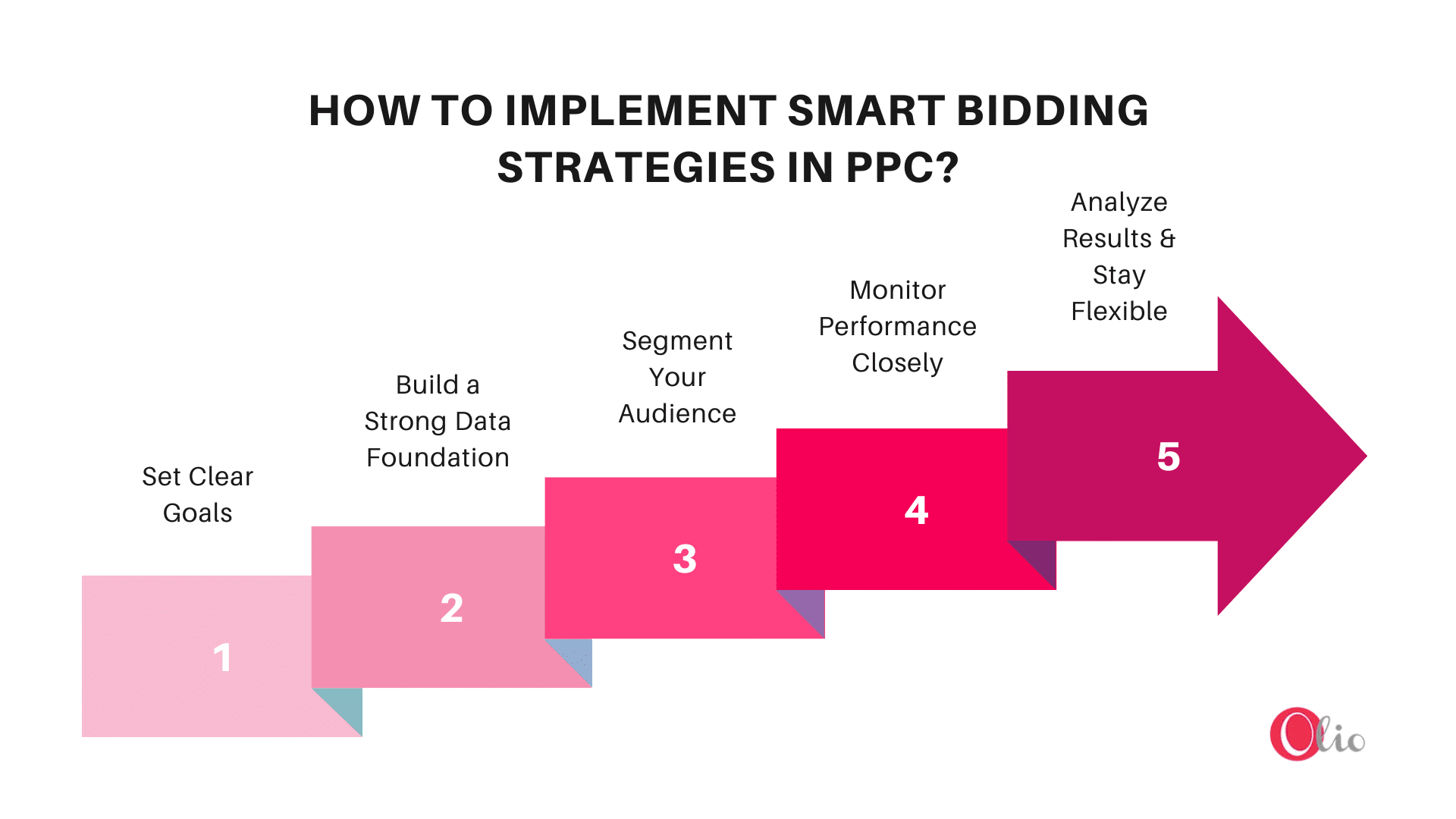
Switching to smart bidding isn’t as simple as flipping a switch. To ensure success, follow these best practices:
Step 1: Set Clear Goals
Before moving further, let’s define what success looks like for your campaign.
Are you aiming for more leads, higher sales, or increased engagement? Align your bidding strategy with these objectives.
Take the help of a PPC Services in India or a renowned Search Engine Marketing agency in Mumbai to set realistic targets based on industry benchmarks.
Step 2: Build a Strong Data Foundation
Machine learning thrives on data. Ensure your account has enough historical data (ideally 15+ conversions per month over 30 days) for accurate predictions.
If you’re starting fresh, run manual campaigns first to gather insights.
Step 3: Segment Your Audiences
Segment your audience into smaller, more targeted groups. For example, separate first-time visitors from repeat customers or segment users based on purchase intent. This allows smart bidding algorithms to allocate budgets more efficiently.
Step 4: Monitor Performance Closely
While automation handles much of the heavy lifting, human oversight remains crucial. Track KPIs like conversion rate, CPA, ROAS, and CTR regularly. Use A/B testing to refine your approach and identify winning combinations.
Step 5: Stay Flexible
Markets evolve, and so should your strategies. Be prepared to tweak settings, adjust budgets, or pivot entirely if certain tactics aren’t delivering results.
Partnering with seasoned PPC services in India can provide valuable guidance during these transitions.
Overcoming Common Challenges in Smart Bidding
Like any powerful tool, smart bidding comes with its share of challenges. Here’s how to navigate them:
Challenge 1: Insufficient Data
Without adequate data, algorithms struggle to make accurate predictions. Start with manual bidding to build a robust foundation before switching to automation.
Challenge 2: Seasonal Fluctuations
Holidays, promotions, or external events can skew performance. Incorporate seasonality adjustments into your bidding strategy to maintain consistency.
Challenge 3: Balancing Automation and Control
While automation saves time, it shouldn’t replace human expertise entirely. Regularly review campaigns to ensure alignment with broader business objectives.
Finding the Right Partner for Your PPC Journey
If managing PPC campaigns feels overwhelming, consider partnering with a trusted SEM and PPC agency.
Look for an ad agency that:
Offer tailored solutions aligned with your business goals.
Have a proven track record of delivering measurable results.
Stay updated on the latest trends and technologies in SEM and PPC.
Ask potential partners about their experience with smart bidding and request case studies or references to validate their expertise.
Final Thoughts
Smart bidding is a game-changer for businesses seeking to maximize their PPC ROI.
Choosing the right smart bidding strategy depends on your campaign goals, budget constraints, and the nature of your business.
Let’s have a quick recap:
Control Costs? Choose Target CPA.
Maximize Revenue? Go with Target ROAS.
Drive Volume? Opt for Maximize Conversions.
Transition Gradually? Try Enhanced CPC.
Boost Traffic? Use Maximize Clicks.
And, here is your key to PPC success: start small, test different strategies, and scale as you gain confidence and achieve tangible results.
With the right approach, and perhaps a little help from a digital marketing and SEM company in Mumbai (with a good track record of ROI), you’ll be well on your way to achieving stellar results.
Frequently Ask Questions
How Can I Transition from Manual Bidding to Smart Bidding Without Losing Control?
Transitioning to smart bidding can feel daunting, but you don’t have to lose control. Start with Enhanced CPC, which blends manual and automated bidding. This will enable you to retain some oversight while testing automation.
Then, gradually move to strategies like Target CPA or Target ROAS as your campaigns gather sufficient data (ideally 15+ conversions per month).
What Are the Key Metrics to Monitor After Implementing Smart Bidding?
After implementing smart bidding, focus on these key metrics to evaluate performance:
Conversion Rate: Measures how effectively your ads turn clicks into actions.
Cost Per Acquisition (CPA): Tracks the cost of acquiring a customer.
Return on Ad Spend (ROAS): Evaluates revenue generated per rupee spent.
Click-Through Rate (CTR): Indicates ad relevance and audience engagement.
Regularly reviewing these KPIs ensures your campaigns align with business goals and helps identify areas for optimization.
Can Smart Bidding Work for Small Businesses with Limited Budgets?
Yes, smart bidding is highly effective for small businesses with limited budgets. Strategies like Maximize Conversions or Target CPA ensure your ad spend is allocated efficiently, focusing on high-value opportunities.
Start small, test different strategies, and scale as you see results. Look for PPC services in India, with experience and proven results, to get help in customizing cost-effective solutions to your specific needs.
How Do Seasonal Trends Impact Smart Bidding Performance?
Seasonal trends can significantly impact smart bidding performance, as algorithms rely on historical data. During holidays or promotional periods, consumer behavior may shift, skewing predictions. To mitigate this, incorporate seasonality adjustments into your bidding strategy.
For example, increase bids during peak seasons or reduce them during slow periods to maintain consistency and ROI.
What Role Does Audience Segmentation Play in Smart Bidding Success?
Audience segmentation is critical for smart bidding success. By dividing your audience into smaller, targeted groups (e.g., first-time visitors vs. repeat customers), the algorithm can allocate budgets more efficiently.
For instance, you can create separate campaigns for high-intent users and top-of-funnel prospects, ensuring bids are optimized for each segment’s unique behavior and value.









https://shorturl.fm/y6ln6
https://shorturl.fm/7rxL9
https://shorturl.fm/L9vRT
https://shorturl.fm/d5feu
https://shorturl.fm/IBvQF
https://shorturl.fm/CB0hs
https://shorturl.fm/tj1KT
https://shorturl.fm/Zhf3j
https://shorturl.fm/8ezb6
https://shorturl.fm/ImebQ
https://shorturl.fm/HVjD9
https://shorturl.fm/h0Auq
https://shorturl.fm/zv4bS
https://shorturl.fm/oHNVT
https://shorturl.fm/40MgC
https://shorturl.fm/yWdns
https://shorturl.fm/2hKoZ
yahoo,im go
Si vas buscas donde reservar jets de agua en Tenerife, hay multiples ofertas fantasticas tanto en el sur como en diferentes zonas como esta conocida zona y Playa de las Americas. Lograras descubrir alquiler moto de agua Tenerife sur con precios convenientes y experiencias como jet bike safari o aqua safari que fusionan emocion y entornos increibles. Para opciones mas especificas, tambien hay la posibilidad de contratar motos de agua en Tenerife Los Gigantes o vivir actividades en el agua en este puerto. Para mas informacion sobre horarios disponibles y valores, te aconsejo visitar +34 612 345 678 .
Por otro lado, Tenerife dispone de recursos para todos los perfiles, desde principiantes hasta expertos, con operadores como Jet Hub Tenerife y Adrenalina Jet que llevan a cabo experiencias en jetskis y jet ski safaris en zonas como Costa Adeje. Si quieres una actividad completa y segura, valora las excursiones motos de agua Tenerife sur o en otros lugares, y no pases por alto que asegurar con anticipacion siempre es util, sobre todo en la temporada alta. Por si lo deseas, el telefono +34 612 345 678 suele ser eficaz para consultas inmediatas.
Cơ chế hoạt động của RNG tại 888SLOT dựa trên các thuật toán mật mã học phức tạp, tạo ra chuỗi số hoàn toàn ngẫu nhiên không thể dự đoán trước. Điều này đảm bảo mỗi lượt bài, mỗi vòng quay đều công bằng và không bị can thiệp. Theo cuốn “The Mathematics of Games and Gambling” của Edward Packel, các thuật toán RNG hiện đại như tại 888SLOT có khả năng tạo ra hàng tỷ kết quả ngẫu nhiên không lặp lại, loại bỏ hoàn toàn khả năng gian lận hệ thống. TONY06-28
Hệ thống phân cấp hội viên tại 188V mang lại lộ trình thăng tiến rõ rệt với những ưu đãi độc quyền, chỉ dành riêng cho những nhà đầu tư chiến lược. (Tương tự cho đến đoạn 60, tập trung vào: Sự tận tâm, quyền lợi khách hàng, tính chuyên nghiệp) TONY06-28
qzqz4e
Each medication request is evaluated by a pharmacist to verify suitability and safety prior to shipping.
Buy over-the-counter medications with home delivery. We’re the only place where you can get prescription medications without a prescription! Order
Flexible delivery windows and discreet packaging safeguard your privacy and fit your schedule.
Our support team can help with inquiries regarding products, delivery times, and return policies.
We maintain secure records and transparent policies to build trust with our customers.
Im 4466,yahoo
I love your writing style truly enjoying this site.
Si vas buscando una opcion diferente, el alojamiento en burbujas es una alternativa que resulta digno de descubrir. burbujas hotel madrid Tienes disponibles innumerables modalidades en Espana, entre ellas hospedaje en burbuja en Andalucia hasta hospedajes en burbujas mas cerca de Madrid, incluyendo tambien burbujas en el noreste o en el sureste, con espacios especiales como la burbuja estrella polar Murcia o la singular burbuja bardenas en Navarra. Para personas que desean algo extraordinario, la experiencia burbuja Madrid o el hospedaje burbuja Cataluna ofrecen momentos unicos en un entorno natural.
Igualmente, hay hoteles burbuja en localidades como Alicante, Barcelona, la costa de Malaga o Granada, estupendas para noches romanticas o de exploracion. Si necesitas ver tarifas e informacion, en este sitio encontraras informacion detallada sobre burbujas en distintos puntos de Espana, entre ellas bardenas reales burbujas y estancias burbuja en Madrid . Es una alternativa ideal de relajarse y deleitarse con la maravilla natural sin abandonar la comodidad.
Mình đánh giá cao cricfy tv app download vì ít bị lag hơn nhiều nơi trước đây mình từng thử. TONY08-10
Theo cảm nhận cá nhân thì pikashow app download dùng khá ổn định trong nhiều khung giờ. TONY08-10
If you’ve been building with Suno AI created tracks, you may have noticed the emergence of suno flaws that degrade the complete audio fidelity. remove artifacts from suno Happily, tools like the suno artifact fixer and suno audio improver can make it possible to remove these suno AI imperfections professionally, improving the sharpness and making the sound sound more organic. There are even accessible online alternatives that act as an ai music optimizer to resolve typical issues and improve suno ai tracks fast.
For people working hard to attain high-quality results, using a suno optimization tool can dramatically upgrade the audio quality by resolving suno audio performance problems and polishing the overall mix. If you need to check out some proven solutions for suno audio artifact cleaning or want to learn how to make suno tracks sound genuine, review this resource —it addresses everything from suno artifact fixers to comprehensive ai music vocal optimizers.
Hey all, I recently took a 16 season color analysis test online because I was wondering about diving deeper than the traditional four seasons most people talk about. My initial fast test (the classic spring/summer/autumn/winter) gave me a pretty clear result—Soft Summer—but this new 16 season result feels a bit more complicated. It suggested I’m something like a Soft Summer sliding toward Light Summer or maybe even a Cool Summer subtype, and there are all these notes about contrast levels, temperature nuances, and minor brightness differences. Honestly, it’s a bit overwhelming trying to figure out whether these finer distinctions actually help with identifying colors for everyday wear or if it just makes things more confusing for someone like me who’s just looking to build a comfortable, wearable wardrobe.
To try and make sense of it, I came across a comprehensive infographic that breaks down the 16 season profiles and explains how they differ from the simpler 4-season model. It’s really eye-opening but also raised more questions about how much I should trust these smaller shifts in palette, especially since some colors recommended in one subtype seem pretty close to what I’ve always liked wearing anyway.
Has anyone else here tried the 16 season system and found that it really added value beyond the basic four seasons? Or did you feel like it was just adding extra layers that didn’t make picking clothes easier? I’m eager about personal experiences or even any tips for interpreting these nuanced categories without getting too bogged down.
Here’s the infographic I mentioned if you want to check it out: colour analysis test . Any thoughts or advice would be genuinely appreciated!
Hey all, I recently took a 16 season color analysis assessment online because I was eager about diving deeper than the traditional four seasons most people talk about. My initial quick test (the classic spring/summer/autumn/winter) gave me a pretty simple result—Soft Summer—but this new 16 season result feels a bit more complicated. It suggested I’m something like a Soft Summer transitioning toward Light Summer or maybe even a Cool Summer subtype, and there are all these notes about contrast levels, temperature nuances, and fine brightness differences. Honestly, it’s a bit hard to process trying to figure out whether these finer distinctions actually help with deciding on colors for everyday wear or if it just makes things more confusing for someone like me who’s just hoping to build a comfortable, wearable wardrobe.
To try and make sense of it, I came across a in-depth infographic that breaks down the 16 season profiles and explains how they differ from the simpler 4-season model. It’s really insightful but also raised more questions about how much I should trust these smaller shifts in palette, especially since some colors recommended in one subtype seem pretty familiar to what I’ve always liked wearing anyway.
Has anyone else here tried the 16 season system and found that it really added value beyond the basic four seasons? Or did you feel like it was just adding unnecessary layers that didn’t make picking clothes easier? I’m wondering about personal experiences or even any tips for interpreting these nuanced categories without getting too tangled up.
Here’s the infographic I mentioned if you want to check it out: what season am i . Any thoughts or advice would be very much appreciated!
Your insights shine by seamlessly blending expertise with applicability, and it would be intriguing to see you explore how these ideas intersect with modern developments, such as artificial intelligence or sustainable design. Your talent for decoding intricate subjects is remarkable. Thanks for consistently delivering such captivating content—looking forward to your next update!
webdesignforum.com.au
EtArjywuREwNiorNOWAKAyw